
SumerSystems Unveils SumerOS, the Operating System That Teaches Computers to Respect the Laws of Physics in Orbit
Nov 28, 2026
SumerSystems Corp. has unveiled SumerOS, a patent-pending orchestration platform for space-based computing that makes thermal, radiation, energy, network and storage conditions first-class inputs to every workload decision. The platform introduces a Physical State Vector for each node and is available today as a demonstration.
Sacramento, United States, November 28, 2026 -- SumerSystems Unveils SumerOS, the Operating System That Teaches Computers to Respect the Laws of Physics in Orbit
Patent-pending platform brings physical-state-aware orchestration to space-based computing for the first time, placing every workload by heat, radiation, power, connectivity and storage, not just CPU and memory
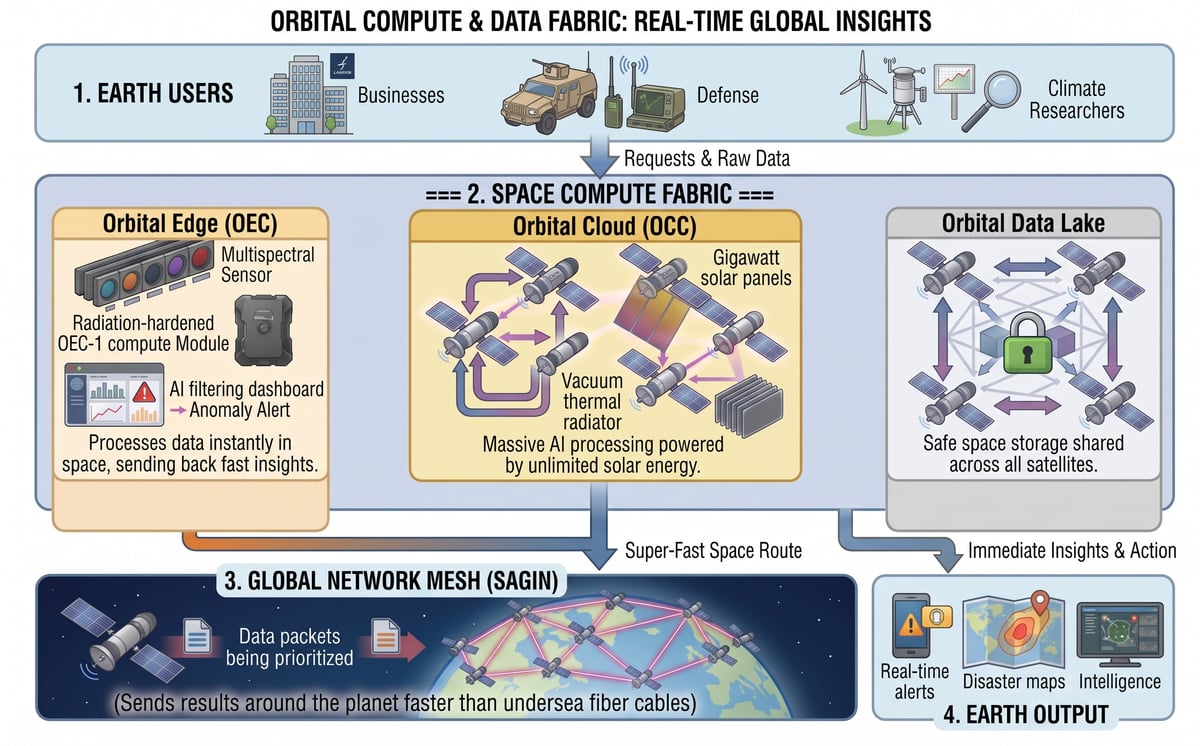
SACRAMENTO, CA – Nov 25th, 2026 – SumerSystems Corp. today unveiled SumerOS, a patent-pending orchestration platform built for a new era of computing in space. As satellites become AI-enabled, autonomous and compute-hungry, SumerOS introduces what the company believes is the first operating layer designed from the ground up to make physical conditions, including thermal margin, radiation exposure, energy reserves, communications windows and storage capacity, first-class inputs to every computing decision in orbit.
Computing in orbit has been running blind
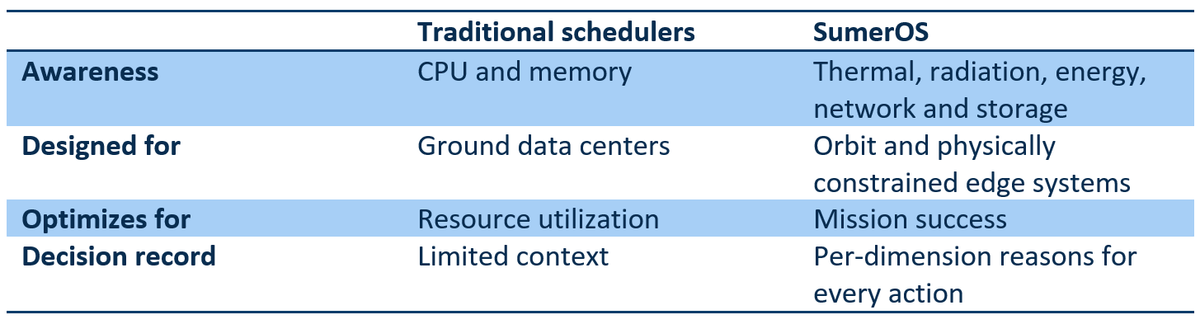
Today's schedulers were built for data centers on Earth. They allocate CPU, memory and storage, and assume the building, the power grid and the cooling system will take care of everything else. In orbit, that assumption breaks. A satellite can have plenty of spare processing power while it is minutes from overheating, about to slip into Earth's shadow and lose solar power, or moving toward a gap in ground communications.
In a single orbit, a spacecraft passes through several entirely different operating environments: sunlit peaks that heat its radiators, short downlink windows with hard deadlines, eclipses that leave it running on battery alone, and radiation passes where the risk of data upsets spikes. A scheduler that ignores these shifts either leaves valuable compute sitting idle or puts the mission itself at risk.
The breakthrough: a Physical State Vector for every node
At the heart of SumerOS is the Physical State Vector, a five-dimensional picture of each computing node's real-world readiness across thermal, radiation, energy, network and storage conditions. Rather than collapsing a node's health into a single number, SumerOS keeps each dimension visible, so operators can see exactly why a node was chosen, excluded or flagged.
Think of it as air-traffic control for computers. Capacity matters, but so do environmental limits, operating windows and contingency plans. SumerOS ranks every eligible node against the specific needs of each workload, excludes nodes in a critical state before ranking begins, and selects from five operational responses:
Place a new workload on the best-suited node
Migrate a workload away from a stressed node
Replicate critical work for added redundancy
Throttle demand to protect thermal and power margins
Defer non-critical work to a better operating window
Every decision is logged with its reasons, giving mission teams a transparent, explainable record rather than a black box.
"For sixty years we have asked how much compute we can launch into orbit. The better question is how intelligently we can use it once it is there," said Ash Sumer, Founder and CEO of SumerSystems. "SumerOS is the first platform built around a simple idea: the computer should understand the physics it lives in. When a satellite knows its own heat, power, radiation and link conditions, it can keep critical work running instead of waiting for something to go wrong."
First to market with a new category of infrastructure software
SumerSystems is entering a market where others are focused on connecting to space or sensing from it. SumerOS is built for computing in it. The company's provisional patent application, filed as "Space-Native Distributed Computing Infrastructure: System and Methods for Orbital Computing, Storage, Networking, Thermal Management, and Autonomous Resource Orchestration," covers physical-state-aware scheduling, thermal-aware workload placement, radiation-aware execution, eclipse-aware energy orchestration, autonomous workload migration, orbital compute orchestration and space-air-ground resource management.
See it in action
SumerOS is available today as a working demonstration environment that combines live orbital data from CelesTrak with simulated spacecraft telemetry. The experience includes a Command Center for fleet posture and decisions, a Digital Twin for node-level exploration, Mission Control for fleet oversight, a Scenario Simulator for testing thermal events, eclipse entry, radiation events and communication interruptions, and an Executive Dashboard for leadership-level visibility.
The company's development roadmap advances SumerOS from today's demonstration toward calibrated physical forecasting, policy-controlled autonomy with human approval and override, and hardware-in-the-loop pilots, so that action authority expands only as test evidence grows.
Early-access pilot program now open
SumerSystems is inviting satellite manufacturers, satellite operators, Earth observation providers, defense contractors and orbital infrastructure companies to join its early-access program. Engagements range from focused evaluation projects to engineering and integration pilots, each designed to answer the question every operator is asking: how do we get the most out of onboard compute without compromising mission reliability?
"Every constellation operator we talk to wants more capability from the hardware already in orbit," Sumer added. "SumerOS gives them a path to get it, with the transparency and safeguards that mission-critical systems demand."
The foundation for the Orbital Compute Network
SumerOS is the first building block of SumerSystems' long-term vision: an Orbital Compute Network that brings AI inference, data storage and high-speed routing to Low Earth Orbit. Spanning Orbital Edge Computing, an Orbital Data Lake, Orbital Cloud Computing clusters and Space-Air-Ground Integrated Networking, the network is designed to run under one scheduling authority, with SumerOS as its control plane. Beyond orbit, the same physical-state-aware approach applies to remote edge sites, telecommunications networks, autonomous defense systems and energy-constrained data centers.
About SumerSystems
SumerSystems, Inc. is developing SumerOS for future distributed computing infrastructure, beginning with orbital use cases and extending toward terrestrial edge and physically constrained systems. Founded by Ash Sumer, whose background spans AI systems, anomaly detection, cloud architecture, cybersecurity and enterprise SaaS, the company is building the software layer that will let computing infrastructure understand and adapt to the physical world around it. Learn more at www.sumersystems.com.
Media Contact
Ash Sumer, Founder and CEO, SumerSystems Corp.
Email: [email protected]
Web: www.sumersystems.com
Forward-looking statements: This release contains forward-looking statements about SumerSystems' products, roadmap and plans. SumerOS demonstration capabilities use simulated telemetry, and planned capabilities remain subject to development, testing and validation. Actual results may differ materially.
Contact Info:
Name: Ash Sumer
Email: Send Email
Organization: SumerSystems Corp.
Website: https://www.sumersystems.com
Release ID: 89211225
Should you detect any errors, issues, or discrepancies with the content contained within this press release, or if you need assistance with a press release takedown, we kindly request that you inform us immediately by contacting [email protected] (it is important to note that this email is the authorized channel for such matters, sending multiple emails to multiple addresses does not necessarily help expedite your request). Our expert team will be available to promptly respond and take necessary steps within the next 8 hours to resolve any identified issues or guide you through the removal process. We value the trust placed in us by our readers and remain dedicated to providing accurate and reliable information.
More News

Mary Jane Veloso on life after death row in Indonesia and finding freedom: ‘I was reborn’
On April 29, 2015, Mary Jane Veloso was preparing to die. The then-30-year-old Filipino woman, who had gone to Indonesia to work as a domestic helper, had spent five years on death row on drug smuggling charges and was due to be executed by firing squad on the prison island of Nusa Kambangan. Twenty minutes before she was to face her executioners, Veloso, a Roman Catholic, made one last appeal to God. “God, many people believe I am innocent. Many people also believe I am guilty. But You know...

DeepSeek is China’s latest developer to worry about losing control of AI
Chinese artificial intelligence start-up DeepSeek has commissioned a third-party evaluation to assess whether its flagship model, V4 Pro, could escape human control, making it the latest Chinese AI developer to signal its concerns with the growing risks surrounding the technology. The evaluation, published on Wednesday by Beijing-based AI safety consultancy Concordia AI, concluded that the model showed “limited ability” to replicate itself or deceive its human creators, though it resisted...
Should AI really be a matter of national security?
In 1810, France granted citizenship to William Cockerill, an English mechanic and engineer, for helping to turn what is today Belgium – beginning near Liege – into one of Europe’s first regions to industrialise after Britain. By today’s standards, Cockerill was engaged in industrial espionage and illegal technology transfer. Though no secret agent, he defied strict British laws that barred skilled artisans from emigrating and from taking industrial secrets, machine models and designs with...

Myanmar’s Asean exit talk: a pariah pushes back
For five years, one name card has been missing from the grand circular table at the Association of Southeast Asean Nations biannual leaders’ summit: Min Aung Hlaing. As president of Myanmar, he should by diplomatic convention sit alongside the 10 other leaders of the Southeast Asian bloc at its regular get-togethers. Yet Asean has kept Myanmar at arm’s length ever since the coup that Min Aung Hlaing led as army chief in February 2021. At its latest summit in Manila this month, Myanmar was...

Philippines could be key player in US-China AI competition
“We’ve just consummated a trade deal, the biggest trade deal we’ve ever made by far and it’s a fair deal for both countries. … It’s a magnificent deal for both,” US President Donald Trump declared as he visited Manila this month. “I’m proud to say that we’re making the alliance between the United States and the Philippines much stronger than it’s ever been before, especially with the consummation of this deal.” Days after Trump’s characteristically superlative pronouncement, however, there are...

In the Shadow of the Afghanistan-Pakistan Border
Among the bombed-out houses along the border, there was no justice to be found, only ruins, lost lives, and people living in the shadow of conflict.

Chen Jining: The Tragedy of the ‘Potential Successor’ in Chinese Politics
The Shanghai party secretary was widely regarded as a possible successor to Xi Jinping – until an investigation was announced.
Indian police rescue 164 Malaysians and Indonesians from Delhi scam ring
Indian police said they had rescued 164 foreign nationals allegedly trafficked into the country and forced to commit online fraud, in a rare case involving victims from overseas. Fraud compounds, where international scammers lure internet users into fake romantic relationships, cryptocurrency investments and betting platforms, are common in Southeast Asia. While similar crimes are also widespread in India, it is much less common for the ringleaders to traffic foreigners into the country to...

Why Goldman Sachs gives Unitree Robotics a sell rating and sees 48% downside
Goldman Sachs has initiated coverage of Unitree Robotics with a sell rating, warning that the Chinese humanoid robot maker’s valuation may have run ahead of its ability to turn an early hardware lead into lasting industrial adoption and profits. In a report published on Thursday evening, the US investment bank set a 12-month price target of 347.10 yuan (US$52), about 48 per cent below Unitree’s closing share price of 666 yuan on the same day. “While we remain structurally constructive on its...

Puma Shen, Critic of China, Could be the Next Mayor of Taipei
Puma Shen, who has been sanctioned by China for his efforts to prepare civilians for an invasion, could become Taiwan’s next political star if he wins.

China’s Tencent makes AI drug discovery breakthrough with Nature paper
Tencent Holdings has published a paper on using artificial intelligence to automate drug discovery in the leading science journal Nature, marking a breakthrough for the Chinese tech giant as it accelerates AI-enabled scientific research. The paper, submitted to the British journal in June 2025 but published on Wednesday, outlines the Shenzhen-based company’s efforts to design novel treatments for obesity, diabetes and cancer with the help of AI. According to the paper, researchers from Tencent’s...

Cash-strapped AirAsia pushes back Malaysian paydays, axes 90 Philippine pilots
Loss-making AirAsia will temporarily delay salary payments to the end of each month, according to the airline on Friday, as it takes measures to conserve cash and its Philippine unit cuts jobs. Confirming an earlier report, the company described the change in the payment schedule for its Malaysian employees, usually paid before the end of each month, as an “operational adjustment” as it aligned internal payroll processes. The move did not represent a change to workers’ salary entitlement, with...
YOUR NEWS, OUR NETWORK.
Do you have Great News you want to tell the world?
Be it updates about your business or your community, you can make sure that it’s heard by submitting your story to our network reaching hundreds of news sites across 6 verticals.