
Cookware Thickness Guide: What mm and Gauge Numbers Actually Mean
Nov 3, 2026
Jiangmen, Guangdong Nov 3, 2026 (Issuewire.com) - Cookware Thickness Guide: What mm and Gauge Numbers Actually Mean Cookware thickness is one of those specifications that shows up on every product page but rarely gets explained. 2.5mm. 18 gauge. "Heavy-duty." What does any of it actually mean, and how much does it matter? After two decades of pressing, forming, and testing stainless steel in our factory, here's what we've learned: thickness matters, but not in the way most marketing copy suggests. It's not a simple "thicker is better" equation. It's a trade-off between heat response, durability, weight, and cost, and the right answer depends on what the pan is supposed to do.
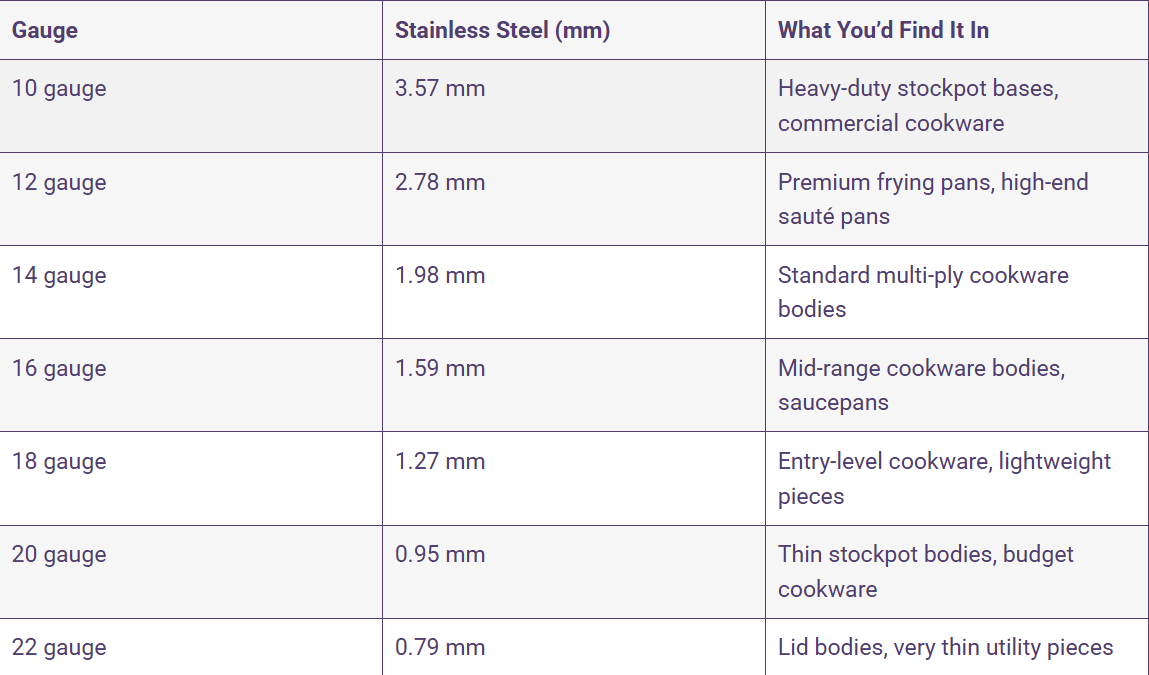
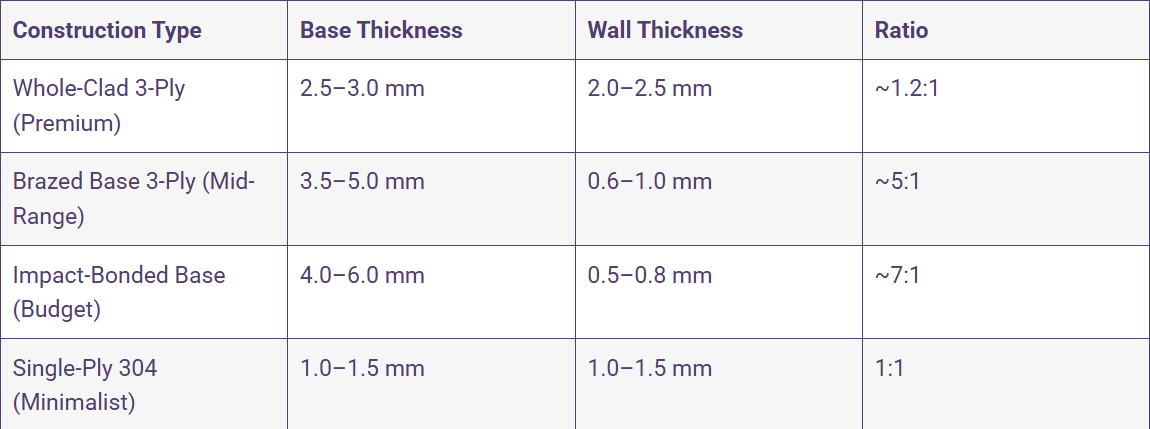
This cookware thickness guide covers thickness from the manufacturing side. What the numbers mean. Where they matter. And where they're being used to sell you something that doesn't hold up. It also answers a question buyers ask often: how thick should stainless steel pans be? How Thickness Is Measured: mm vs Gauge The millimeter system In manufacturing, cookware thickness is measured in millimeters (mm), the actual distance between the inner cooking surface and the outer surface of the pan. This is what's on the spec sheet, what the QC team checks with calipers during production, and what determines how the pan performs. Millimeter measurements are direct. If a pan is spec'd at 2.5mm, the caliper reads 2.5mm. No conversion needed. The gauge system, and why it's confusing Gauge is an older measurement system inherited from sheet metal industries. The critical thing to understand: gauge numbers run in reverse. A lower gauge number means thicker steel. An 18-gauge pan is thinner than a 10-gauge pan. The second source of confusion: gauge values are different for different metals. A 16-gauge stainless steel sheet is not the same thickness as a 16-gauge aluminum sheet. If a product page says "16 gauge" without specifying the metal, the number is meaningless. Stainless steel gauge-to-mm conversion This conversion table is one of the most useful things you can keep when evaluating cookware specs. Most consumer guides mention gauge without ever giving the actual numbers. Now you have them. Base Thickness vs Wall Thickness: They're Not the Same This is one of the most common misconceptions in cookware buying, and one that manufacturers rarely clarify on product pages. The base does the heavy lifting The base (bottom) of a pan is where heat enters. It needs mass to absorb energy from the burner, distribute it evenly across the cooking surface, and hold it steady when food hits the pan and drops the surface temperature. In quality cookware, the base is almost always thicker than the walls. This is deliberate engineering, not cost-cutting. The base needs thermal mass. The walls need to be lighter so the pan is manageable and responds to heat adjustments. Wall thickness: a different job The walls of a pan don't need the same thermal mass as the base. Their job is containment, holding food and liquid, and contributing to overall pan rigidity. Wall thickness affects denting resistance, warp resistance, and weight. Typical thickness ratios in production The pattern is clear: premium whole-clad cookware has a moderate base-to-wall ratio because the entire pan is built from the same multi-layer sheet. Budget constructions pile thickness into the base while keeping walls thin to control cost. Both approaches work, but they produce very different cooking experiences. Readers can explore the whole-clad stainless steel cookware sets (https://jincui.com/whole-clad-stainless-steel-cookware-sets/) from JC Cookware to see the premium construction described above. What Thickness Actually Affects (and What It Doesn't) What thickness directly controls Heat distribution: A thicker base spreads heat more evenly because it has more metal mass to conduct thermal energy laterally. This reduces hot spots. Heat retention: More mass means more stored thermal energy. When you drop a cold steak into a thick pan, the surface temperature drops less than it would in a thin pan. Warp resistance: Thin pans warp. When metal heats unevenly, the hotter areas expand more than the cooler areas. If the metal is thin, this differential expansion bends the pan. Dent resistance: A dropped pan with 0.6mm walls will dent. One with 2.0mm walls might get a scratch. What thickness doesn't control Food sticking: Sticking is about surface texture (Ra value) and temperature at the food-metal interface. A poorly finished 3mm pan will stick worse than a properly finished 1.5mm pan. Corrosion resistance: The stainless steel grade (304, 316, 430) determines corrosion resistance, not thickness. Induction compatibility: Induction works by magnetic response, which depends on the steel grade, not thickness. Non-stick performance: No relationship whatsoever. Thickness has zero effect on whether eggs slide off the surface. Multi-Ply Thickness: Breaking Down the Layers Multi-ply (clad) cookware adds a layer of complexity, literally. The total thickness number on the spec sheet is the sum of multiple metal layers, and the composition of those layers matters more than the total.
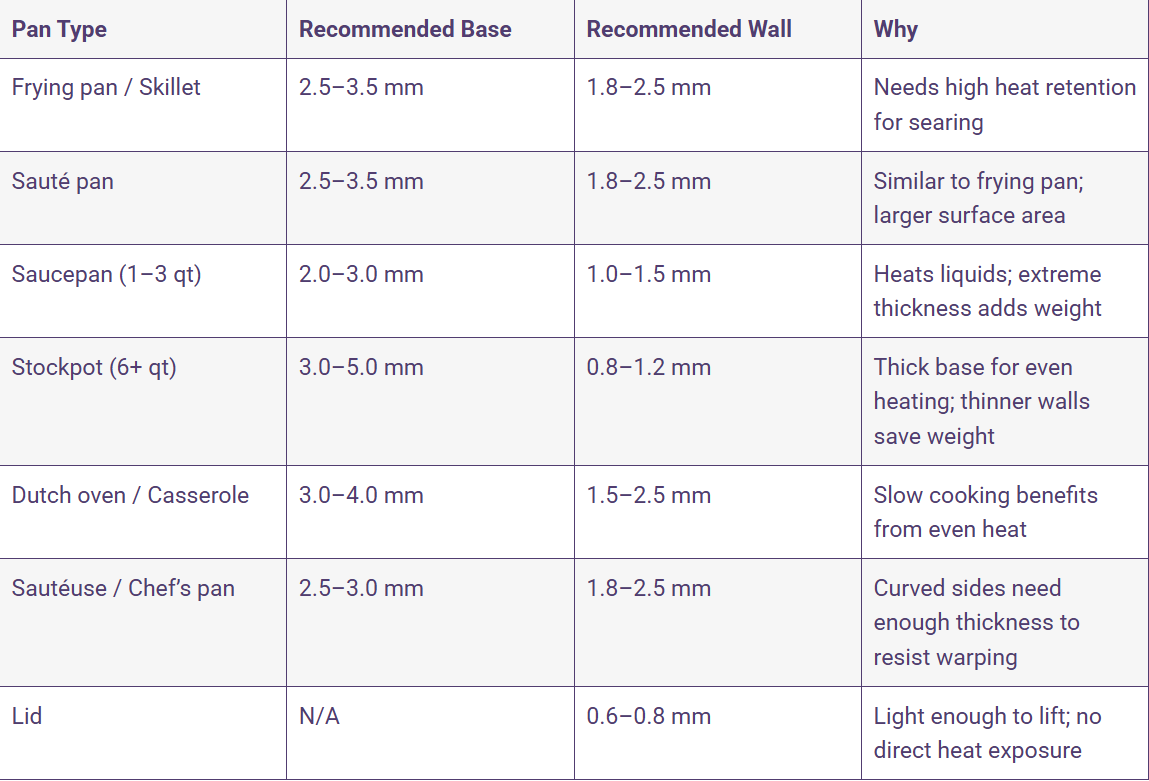
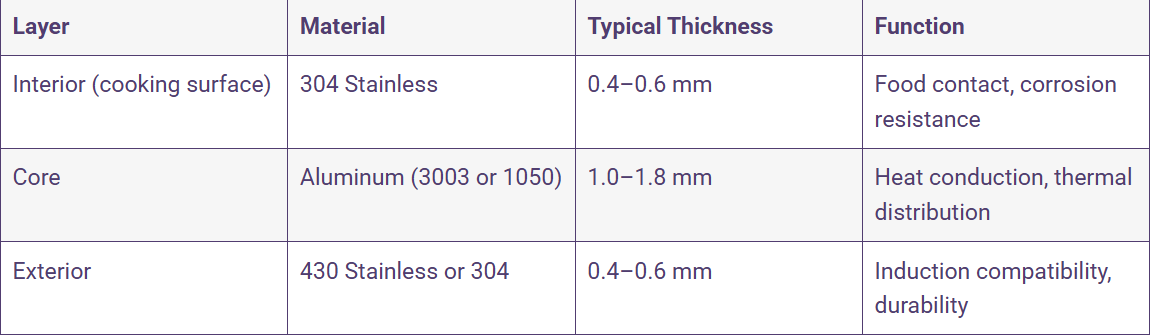
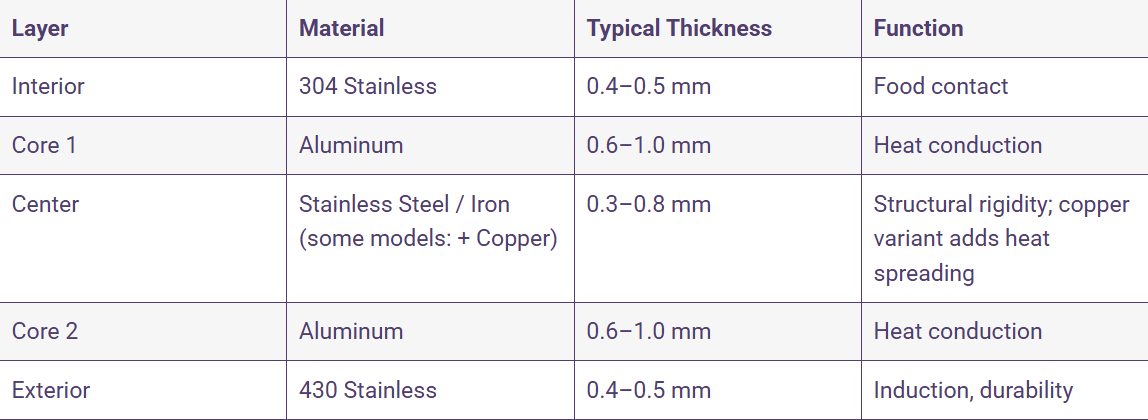
Typical 3-ply construction Total: 1.8-3.0 mm Typical 5-ply construction Common structure: Stainless Steel - Aluminum - Stainless Steel/Iron - Aluminum - Stainless Steel. Some models add a copper layer at the center for enhanced thermal conductivity. Total: 2.3-3.8 mm The aluminum core is the real thickness story In a typical 3-ply pan, the aluminum core is 2-3 times thicker than either stainless layer. This is because aluminum conducts heat roughly 15 times better than stainless steel. The aluminum layer is the thermal engine; the stainless layers are protective cladding. A 2.5mm "thick" pan with a 0.8mm aluminum core will perform worse than a 2.0mm pan with a 1.4mm aluminum core. Total thickness alone doesn't tell you the thermal story. You need the layer breakdown. What to ask your supplier about multi-ply Total thickness Number of layers Material and thickness of each layer Whether the construction is whole-clad (layers extend up the walls) or base-only If a supplier can't give you the layer-by-layer breakdown, you're buying a total thickness number without knowing what's inside it. For base-only designs, see the encapsulated bottom stainless steel cookware sets (https://jincui.com/encapsulated-bottom-stainless-steel-cookware-sets/) range. How Thickness Affects Different Pan Types Not every pan needs the same thickness. A stockpot and a frying pan have fundamentally different jobs. The pattern: pans that sear need thickness. Pans that boil water don't. Pans with large flat bottoms need more thickness to resist warping than pans with small bases. For B2B Buyers: Thickness as a Sourcing Specification When you're specifying thickness in a purchase order or OEM agreement, precision matters. Here's what to include, and what to watch for. What to specify Base thickness at center and edge: Measure at the center of the base (thickest point) and 10mm from the edge (thinnest point). Wall thickness at mid-height: The wall thins slightly from base to rim during forming. Specify mid-height as the measurement point. Tolerance range: Typically ±0.2mm for base thickness and ±0.15mm for wall thickness in quality production. Layer breakdown for multi-ply: Total thickness alone is not enough. Specify individual layer thicknesses and materials. What to watch for "Heavy-gauge" without numbers: A marketing term, not a specification. If the spec sheet doesn't have a number, ask for one. Total thickness without layer breakdown: A 3mm pan could be excellent or poor depending on layer composition. Thickness claims without measurement position: "2.5mm thick" -- where? Base center? Base edge? Wall? Gauge numbers without the metal type: "16 gauge" means different things for different metals. The Minimum Thickness Rule: What's Too Thin From our production experience and returned product analysis, here's where thin becomes a problem: Frying pan: too thin if the base is under 1.8 mm or the wall is under 0.8 mm. Sauté pan: too thin if the base is under 2.0 mm or the wall is under 0.8 mm. Saucepan: too thin if the base is under 1.5 mm or the wall is under 0.6 mm. Stockpot: too thin if the base is under 2.5 mm or the wall is under 0.6 mm. Below these thresholds, you start seeing systematic issues: warping within the first year, denting from normal handling, hot spots that burn food, and the lightweight feel that signals "budget" to a customer who picks up the pan. This isn't to say thinner pans are unsafe or unusable. They're just built to a different price point, and both the retailer and the end customer should understand what they're getting. Frequently Asked Questions Is thicker cookware always better? No. Thickness improves heat retention and warp resistance, but it also increases weight, slows heat-up time, and raises cost. A 3.5mm frying pan is excellent for searing. A 3.5mm stockpot is unnecessarily heavy and slow to boil water. The right thickness depends on what the pan is for, and who's using it. What's the difference between 3-ply and 5-ply in terms of thickness? 5-ply typically adds 0.5-1.0mm of total thickness compared to 3-ply, with the extra layers usually being additional aluminum or a thin copper core. Whether this is worth it depends on the layer composition. A well-designed 3-ply pan with a thick aluminum core will outperform a 5-ply pan with multiple thin aluminum layers. How can I check cookware thickness without special tools? You can't measure thickness precisely without calipers or a micrometer, but you can assess it roughly by weight relative to pan size. A 10-inch (25cm) frying pan that weighs under 1.5 kg is almost certainly on the thin side. One that weighs 2.0-2.5 kg is likely in the 2.5-3.0mm range. Does the thickness of stainless steel affect how quickly it heats up? Yes, and this is where the trade-off lives.
A thicker pan takes longer to reach cooking temperature because it has more metal mass to heat. But once hot, it holds temperature more steadily. Professional cooks generally prefer the thicker option because temperature stability matters more than heat-up speed. Why do some expensive pans feel thinner than cheaper ones? Because they're designed differently. Premium whole-clad cookware often has uniform thickness from base to rim (around 2.0-2.5mm throughout), which can feel "thinner" than a budget pan with a massive 5mm impact-bonded base and paper-thin 0.6mm walls. Judge by performance, not by how thick the base looks. About JC Cookware JC Cookware has manufactured stainless steel cookware since 2003 in Xinhui, Jiangmen. Our production covers whole-clad 3-ply, brazed-base, and impact-bonded constructions across frying pans, saucepans, stockpots, and cookware sets. We provide full layer-by-layer thickness specifications with every OEM/ODM order. Visit our contact page (https://jincui.com/contact-us/) for sourcing inquiries or to request thickness samples.
Source :JC cookware
This article was originally published by IssueWire. Read the original article here.
More News

Australian Court Hears Challenge to Social Media Ban
Reddit and an Australian digital advocacy group are claiming a law that restricts children younger than 16 from popular platforms infringes on their constitutional rights.

China’s Message to Its Rivals: You Need What We Make
It’s not just rare earths. China is making it harder for other countries to shed their dependence on its solar, drone and drugmaking technology.

Melaka election tests Malaysia’s fragile unity government as partners clash
Malaysia’s unity government is facing an increasingly uncomfortable test ahead of the election in Melaka state, with parties governing together in Kuala Lumpur reverting to old rivalries as they compete for votes in a contest that could foreshadow shifting alliances before national polls due over a year from now. Prime Minister Anwar Ibrahim’s ruling Pakatan Harapan (PH) coalition is under pressure to put on a strong showing in an uphill battle against federal partners Umno, which is widely...

Outrage in Philippines as pet remains found dumped in sacks on vacant plot
The discovery of dozens of pet remains dumped in sacks along a roadside in the Philippines has sparked public outrage and raised questions over whether the country’s animal welfare laws adequately protect pets after death. A pet crematorium in Bacoor, Cavite province – nearly three hours’ drive from the dumping ground in neighbouring Bulacan province – has been ordered to shut following complaints from pet owners, as police investigate allegations that the business improperly disposed of animals...

Singapore eyes regional haze control centre in Indonesia as Asean chair
Singapore will work with Asean member states to strengthen the implementation of an agreement on transboundary haze when it chairs the regional bloc next year, the country’s environment minister said on Tuesday. It will also work with the bloc to establish the Asean Coordinating Centre for Transboundary Haze Pollution Control in Indonesia, said Minister for Sustainability and the Environment Grace Fu. In response to questions in parliament, Fu said the coordinating centre will strengthen...
Malaysia’s halal chicken scandal exposes hygiene breaches at filthy plant
Malaysia’s halal safeguards are under scrutiny after filthy conditions and suspected slaughtering breaches at a chicken plant sparked demands to explain how it ignored warnings and operated for years without certification. The hygiene failures at the Puchong facility came to light after authorities seized more than 6.5 tonnes of chicken during a raid last week. The factory, which processes more than 40,000 chickens daily and supplies businesses across the Klang Valley in Kuala Lumpur, is accused...
Tokenised gold bar to advance Hong Kong’s ambitions as digital, metal trading hub
Hong Kong’s plan to start an interbank tokenised gold transaction project marks a crucial step in its quest to make itself a key global hub for the precious metal, according to analysts. The city planned to launch a gold token representing a standard 400-ounce gold bar, referencing HAU, Hong Kong’s ticker for gold prices launched earlier this year, said Secretary for Financial Services and the Treasury Christopher Hui Ching-yu during the annual Fintech Week event on Monday. He said the effort...

North Korean Hackers Stole Billions, the F.B.I. Says. It’s Not Their First Heist.
This week’s $6.3 billion hack of Binance is the largest to hit crypto, and would be the most that North Koreans have stolen in years of brazen cybercrime.

South Korea rushes to reissue passports to President Lee, wife after data leak
South Korea’s foreign ministry said on Tuesday it was taking steps to reissue passports for all 168 people affected by an online leak of sensitive personal information, including President Lee Jae Myung and first lady Kim Hea-kyung, as police investigate how the data was exposed. “The foreign ministry is swiftly taking measures to ensure the smooth reissuance of passports for all affected individuals, including the president and first lady,” ministry spokesman Park Doo-soon said during a...

Is Sara Duterte’s impeachment case being sped up due to Filipinos’ ‘growing impatience’?
The impeachment trial of Philippine Vice-President Sara Duterte-Carpio may soon draw to a close after the prosecution decided to drop several of her charges, a move that legal experts have said is intended to speed up the trial and secure a conviction by focusing on the strongest evidence against her. Beyond the trial, the decision could have significant political implications for the 2028 presidential race, with a swift verdict potentially removing a strong candidate, according to analysts. On...

Australia jails Singaporean tourist for fatally driving over man who stole backpack
A 29-year-old Singaporean man was sentenced to five years and nine months’ jail in Australia on Monday after he killed a man who stole a backpack from his rental car. Lincoln Ng Jing Kai chased the man in a car and knocked him off his e-bike before driving over him. He was originally charged with murder, but pleaded guilty to manslaughter in August after prosecutors agreed to accept the lesser charge. Sentencing him, Judge Terence Palmer said Ng’s actions “involved an element of taking the law...

North Korea’s low-cost drone push exposes South Korea’s red tape trap
North Korea is rapidly advancing its drone warfare capabilities by drawing lessons from the Russia-Ukraine war, even as South Korea’s efforts to keep pace remain bogged down by procurement delays and bureaucratic red tape, observers warn. They also caution that cryptocurrency theft has become a crucial source of funding for Pyongyang’s weapons programmes, following US Federal Bureau of Investigation allegations that North Korean state-backed hackers stole more than US$6 billion from Binance, the...
YOUR NEWS, OUR NETWORK.
Do you have Great News you want to tell the world?
Be it updates about your business or your community, you can make sure that it’s heard by submitting your story to our network reaching hundreds of news sites across 6 verticals.